
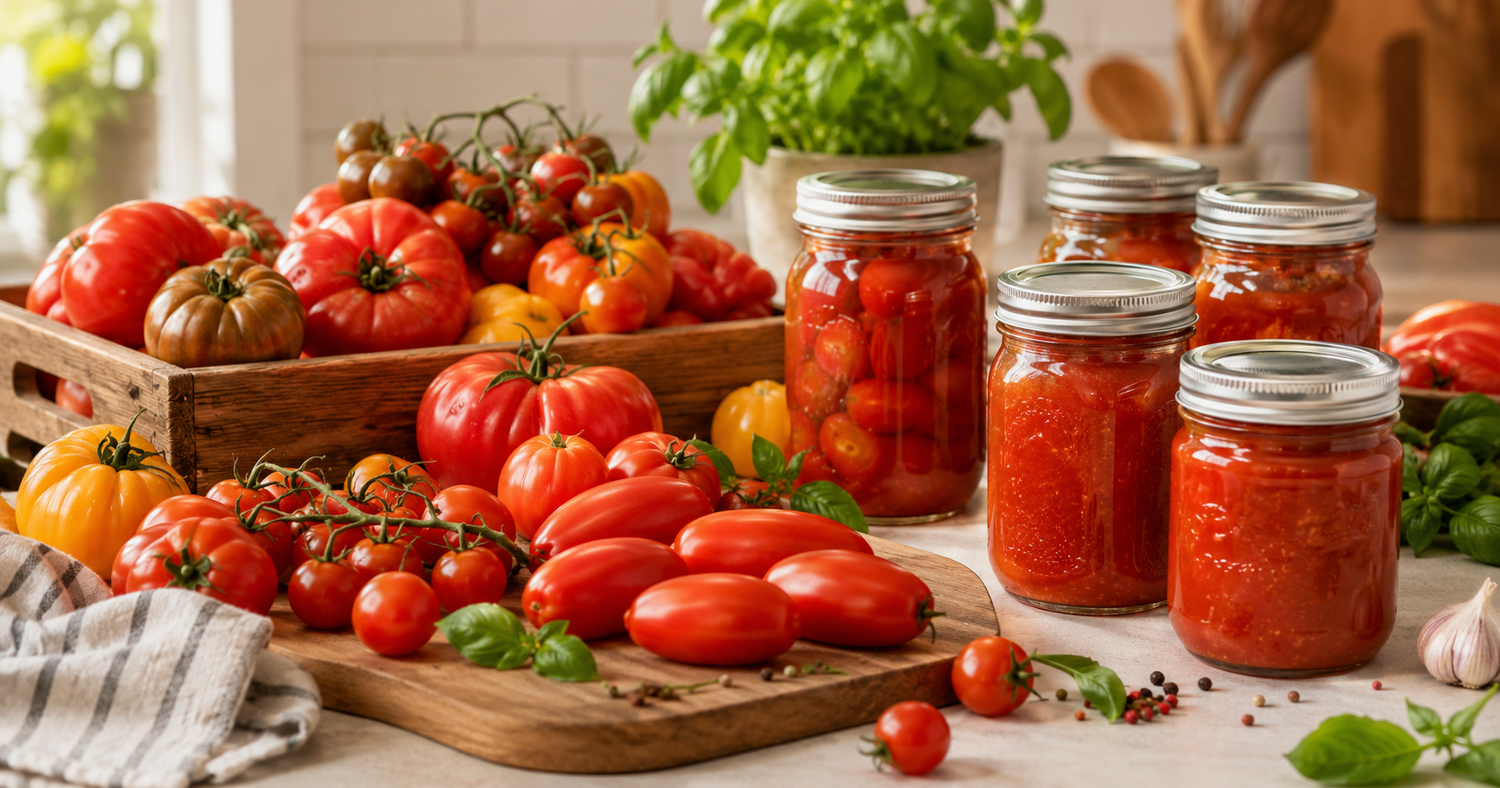
Tomato season is one of those little pleasures we’d love to make last a little longer.
But how well do you really know the tomato? From its origins in the Americas to the best ways to store it—not to mention a few surprising facts and tips for reducing food waste—here’s everything you need to know to fully enjoy locally grown tomatoes… and extend summer a little longer in your kitchen.
In this article
- The tomato comes from the Americas
- Italians haven’t always eaten tomatoes!
- Fruit or vegetable?
- Not all tomatoes are red
- The refrigerator isn’t always a tomato’s best friend
- What about green tomatoes?
- Don’t throw away the skins!
- One last important tip for homemade preserves
- Tip to reduce food waste: Freeze them whole
- Choosing the Right Tomato
- Canning or freezing?
- Recipes to Make the Most of Your Tomatoes
The tomato comes from the Americas
Although we now instinctively associate it with Italian and Mediterranean cuisine, the tomato is native to the Americas. Its wild ancestors come primarily from western South America, while its domestication and diversification are closely linked to Mesoamerica.
Europeans discovered the tomato after their arrival in the Americas, and it was introduced to Europe in the 16th century.
Italians haven’t always eaten tomatoes!

It’s hard to imagine Italian cuisine today without tomato sauce, pizza, or pasta al pomodoro.
Yet the tomato didn’t arrive in Italy until the 16th century and took a long time to truly become a staple of the European diet. It was initially grown as an ornamental plant and even aroused some suspicion.
It was only gradually, particularly starting in the 17th and 18th centuries, that it began to play a more prominent role in Italian cuisine.
In other words, pasta existed long before tomato sauce!
Fruit or vegetable?
Botanically speaking, the answer is clear: the tomato is a fruit.
It develops from a flower and contains the plant’s seeds. It is therefore a fruit in the same sense as a bell pepper, an eggplant, or a zucchini. In cooking, of course, its low sugar content and its primarily savory uses mean that it is generally considered a vegetable.
A cooked tomato may have an advantage over a raw tomato. Tomatoes are particularly known for containing lycopene, an antioxidant pigment largely responsible for their red color.
Interesting fact: cooking and processing tomatoes can make lycopene more easily absorbed by the body. And since lycopene is fat-soluble, eating tomatoes with a source of fat, such as a drizzle of olive oil, can also promote its absorption.
Not all tomatoes are red
Yellow, orange, green, pink, purple, almost black, or even striped: there is an incredible variety of tomatoes.
Heirloom varieties, in particular, allow you to discover this diversity of colors, as well as shapes, textures, acidity, and flavors. Some are very sweet, others more tart, meaty, or particularly juicy.
The refrigerator isn’t always a tomato’s best friend
A tomato that still needs to ripen is generally best stored at room temperature.
Cold temperatures can alter its texture and diminish some of its aromas. To fully enjoy a beautiful, in-season tomato, it’s best to avoid refrigerating it unnecessarily.
However, when a tomato is very ripe and you want to extend its shelf life, the refrigerator can be useful. Take it out a while before eating it so it can return to room temperature.
What about green tomatoes?

A green tomato isn’t necessarily a specific variety—it may simply be a tomato that hasn’t ripened yet.
At the end of the season, rather than letting the green tomatoes go to waste on the plants, you can use them to make chutney, relish, or marinade—or prepare the famous fried green tomatoes.
Some varieties, however, remain naturally green even when ripe.
Don’t throw away the skins!
When you’re preparing a large quantity of tomatoes and your recipe calls for peeling them, the skins can be given a second life.
Dry them in the oven or a dehydrator until they’re completely dry, then grind them into a powder.
This tomato powder can then be used to season a salad dressing, pasta, mayonnaise, popcorn, potatoes, or a spice blend.
The same goes for scraps: before throwing them away, think about using them in a sauce, broth, or cooking!
One last important tip for homemade preserves
Canning tomatoes requires more care than simply filling jars with hot sauce.
The acidity of tomatoes varies depending on the variety, their ripeness, and growing conditions. Therefore, you should not determine the safety of a preserve based solely on the variety of tomato used.
For preserves intended to be stored at room temperature, always use a proven recipe and canning method, particularly regarding acidification, processing time, and jar size.
If you don’t want to try your hand at canning, freezing is still an extremely simple way to enjoy summer tomatoes during the winter.
Tip to reduce food waste: Freeze them whole
Do you have too many tomatoes and no time to make sauce?
Wash them, dry them, and freeze them whole.
Of course, they won’t have the same texture as a fresh tomato after thawing, but they’ll be perfect for sauces, soups, and stews.
Bonus: After freezing, the skin usually peels off very easily.
Choosing the Right Tomato
The Roma tomato: a sure bet for canning

With its firm flesh, low moisture content, and few seeds, the Roma tomato is particularly well-suited for making thick, flavorful preserves.
Ideal for:
- sauces
- tomato purees
- chopped tomatoes
- homemade preserves
Cherry Tomatoes: Small but Versatile

Cherry tomatoes are full of flavor and can easily be canned whole. Their skin also helps the tomatoes retain their shape.
Ideal for:
- whole canned tomatoes
- roasted tomatoes
- sun-dried tomatoes
Beefsteak: perfect for dishes that call for texture

Large, meaty, and especially juicy, the Beefsteak tomato is a great choice when you want to preserve nice, large pieces of tomato.
Ideal for:
- sauces
- salsas
- homemade ketchup
- freezing
San Marzano: The Queen of Italian Sauces

Elongated and meaty, the San Marzano tomato is known for its mild flavor and low acidity. It’s an excellent choice for making rich, creamy sauces.
Ideal for:
- Italian sauces
- tomato purees
- chopped tomatoes
Heirloom Tomatoes: Preserving the Flavors of Summer

Colorful, fragrant, and available in a wide variety of types, heirloom tomatoes each have their own unique character. Since they can be very juicy, freezing is a simple way to preserve their flavors.
Ideal for:
Canning or freezing?
The best method depends mainly on the variety you choose and how you plan to use them.
Fleshy tomatoes with lower water content, such as Roma and San Marzano, are particularly well-suited for sauces and canning. Larger or very juicy varieties, on the other hand, are best frozen for later use in cooking.
Recipes to Make the Most of Your Tomatoes
Now that you know which tomatoes to choose and how to store them, all that’s left is to cook with them. From sauces, soups, and stews to pasta dishes and fresh recipes, discover our ideas for getting the most out of locally grown tomatoes—during the season… and long after!


